I started Tolstoy's masterpiece about three months ago, and just finished with it yesterday. I loved it, but it is a bit overwhelming. All of the characters get confusing, until you're about one hundred pages in. I do enjoy a good Russian family drama, though!
My one point of concern is the ending. Neither the "original" ending of Anna's train "misadventure" (don't want to ruin it for those who have not read the book) nor the musings of Levin really did it for me. I would say the ending is Anna Karenina's weakness. It actually makes me feel better about my writing that even a master like Tolstoy had trouble with his endings! And, actually that might be the greatest critique of all, and why his tomes are dangerously large.
Anna is so wonderfully characterized that I can see her, touch her, even smell her perfume as she wafts from room to room. The same with Vronsky, Oblonsky, Levin, Kitty, Dolly and the rest. I felt like I was a part of the family by the time I put the book down, satisfied but still in doubt. I wanted more.
Needless to say, the new film with Keira Knightly was not my cup of tea. I found it horrible and pretentious and should have left the theater when Tom Stoppard's name appeared as the screen writer. It was so self-conscious, and so British that I just couldn't stomach it. I don't even feel the movie deserves its own review, to be honest. Keira is too much of an acting lightweight to do justice to the role of ANNA but at least he costumes were fabulous!
If you really want to see a good screen version of Anna Karenina, I suggest the 1935 one with Greta Garbo. Now there is a femme fatale! Otherwise the 1948 Vivien Leigh version is also good, but a little melodramatic, as is par for the course with Leigh.
Showing posts with label 19th century. Show all posts
Showing posts with label 19th century. Show all posts
Tuesday, March 12, 2013

Saturday, January 19, 2013
A Trip to Aix-en-Provence

At the beginning of the month, Epiphany to be exact, I made it up to Aix-en-Provence to look around and do a little shopping. I ended up buying an incredibly delicious chèvre cendrée (goat's cheese with an ash rind--it sounds gross, but it is not! Just don't eat the ash) and Turkish apricots that were to die for at the farmer's market; drooling over a pair (...make that several pairs...) of Ubu earrings at a boutique; and hightailing it to the Musée Granet to see some of the lovely works of native son Cézanne--as well as other Impressionist, etc., artists.
 |
| Paul Cezanne lived here once |
 |
| Santons: little figures for your Nativity scene made in Aix! |
Here are some more pictures of santons:


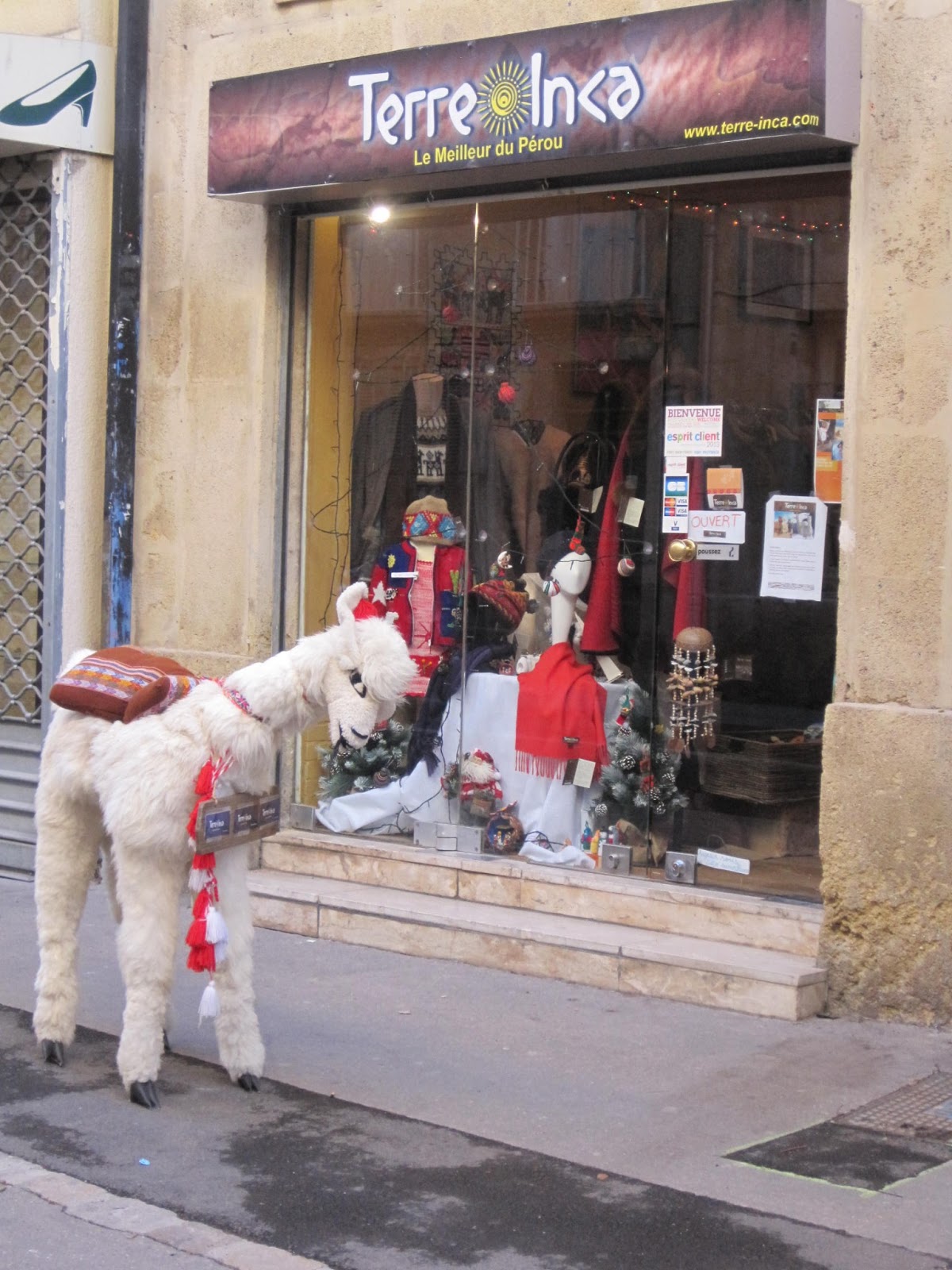
And here are more pictures of Aix:
 |
| Hotel de Ville |


 |
| A protest?!? In FRANCE?!? |


One thing I learned at the museum, which was small but good, is that Cézanne and Emile Zola met when they were kids at school, and continued a lifelong friendship, even after they each became famous! Definitely cool. I also learned the French for "still life": nature morte. It just seems so much more philosophical and expressive!
Here is a famous Cézanne nature morte:

Monday, November 5, 2012
Chantiers Navals
Last week, I went to the old shipyards in La Ciotat as part of a tour with Maria, the Spanish assistant.

 The shipyards were once the biggest employer in La Ciotat, mainly producing naval ships, cargo ships, and big oil tankers for the French Navy, but they closed down production in 1988, due to the downsizing of the Navy, and the lower cost of producing ships in the Nord-Pas-Calais region of France, which has been a notable industrial center for hundreds of years.
Currently, the shipyards are still in business, but privately: a yacht-building company is housed on the property, and, although they employ some Ciotadens, they do not quite have the output the French Navy had in its time. The work is mainly yacht repair, not building new ones, on commission from rich people wintering in St. Tropez or the like. They repair 500 yachts per year, according to the website.


The history of the chantiers navals in La Ciotat begins in 1851, when, shortly before the start of the Seconde Empire, Napoleon III commissioned the construction of steam ships which were destined to sail out of Marseilles as imperial freight ships. This was changed to "national" freight ships once the third republic was instated in 1870.

The area near the shipyards was designated solely for shipyard workers. A mini-town sprang up next to the docks, separated from the rest of La Ciotat. In the 1860s, it was top-of-the-line, very modern and very chic. Today, most of the housing is abandoned, since the shipyard closed its doors, and the town that once was is desolate. There are bits of the "shantytown" that have been incorporated into the rest of the downtown area, mostly housing restaurants and souvenir shops now. Some were demolitioned in 2007 when the yachting company requisitioned the old shipyard, and the only nightclub in La Ciotat (Sur les Quais - On the Docks) is found in the new building.
 In 1916, the dock workers unionized, creating the Société provençale de constructions navales, or the Provence Shipworkers' Union, taking part in the global movement of Socialism and the working man's rights. This really helped morale during World War I, when there was a huge rush in business. There was another big uptick in workload again during World War II. The Société was replaced by the Chantiers navals de La Ciotat in 1940, which is what some locals still call it. The name was changed again in 1982, but I don't remeber what they changed it to.
  Now, during the off-season, they give tours of the shipyard to those interested.On our tour, there were a lot of little old ladies who seemed to know more than the tour guide and kept interrupting him every six seconds. Our coordinator, Mme. R, signed us up for the tour, as something to do during the long vacances de Toussaint. Unfortunately, it rained cats and dogs all morning during the tour, and even though I was wearing a heavy-duty camping rain jacket, I was completely soaked from head to foot--even my hair got wet through the hood!
As you can see, I got some photos in, but I was terrified I'd break my camera by shorting out the flash or the battery. I did actually do that once with a different camera in Dresden. I took pictures while it was raining and slid the camera into my rain jacket pocket to discover later that it was trashed. NOT FUN! I guess the Le Mistral is to blame? That or plain old autumn weather. At least there is always hot cocoa and pain au chocolat to warm up with at home!

Thursday, October 18, 2012
What's in a Name? Part II
The name a person goes by seems to be a perennial topic for me, and I'm not quite sure why. Maybe it's an existential thing. Who are we? Who am I? Who are you? A lot of how we see ourselves resides in what we call ourselves.
Here in France, there is a different naming culture and naming tradition than in other parts of the world. In the 19th century, Napoleonic law dictated that children born in France could only be named from a list of 20 or so names he personally chose--most of them religious--and spelled "correctly" by a priest or other notary public. This had been common in Europe since the middle ages, but Napoleon was among the first European rulers to mandate the practice into law. To differentiate, people gave their children multiple first names. This is why the French are so keen on hyphenated names to this day. Claude-André, Anne-Mireille, and the classic Jean-Pierre, to name a few...
One thing I've noticed is that, since I have my list of students' names before I get to meet the actual students, there is a gender difference between the United States and France. There is also a heavy Italian and North African influence in this area.
Here are some common boy's names I thought were girl's:
Andrea
Alexis
Camille
Jules-Antoine
Maxime
Morgan
Yanisse
And some common girl's names I thought were boy's:
Dorine
Laurence
Marion
Patrice
Sandy
Siwar
Valentine
I'll get the hang of it some day soon. Maybe by the end of the year.
Here in France, there is a different naming culture and naming tradition than in other parts of the world. In the 19th century, Napoleonic law dictated that children born in France could only be named from a list of 20 or so names he personally chose--most of them religious--and spelled "correctly" by a priest or other notary public. This had been common in Europe since the middle ages, but Napoleon was among the first European rulers to mandate the practice into law. To differentiate, people gave their children multiple first names. This is why the French are so keen on hyphenated names to this day. Claude-André, Anne-Mireille, and the classic Jean-Pierre, to name a few...
One thing I've noticed is that, since I have my list of students' names before I get to meet the actual students, there is a gender difference between the United States and France. There is also a heavy Italian and North African influence in this area.
Here are some common boy's names I thought were girl's:
Andrea
Alexis
Camille
Jules-Antoine
Maxime
Morgan
Yanisse
And some common girl's names I thought were boy's:
Dorine
Laurence
Marion
Patrice
Sandy
Siwar
Valentine
I'll get the hang of it some day soon. Maybe by the end of the year.
Subscribe to:
Posts (Atom)